
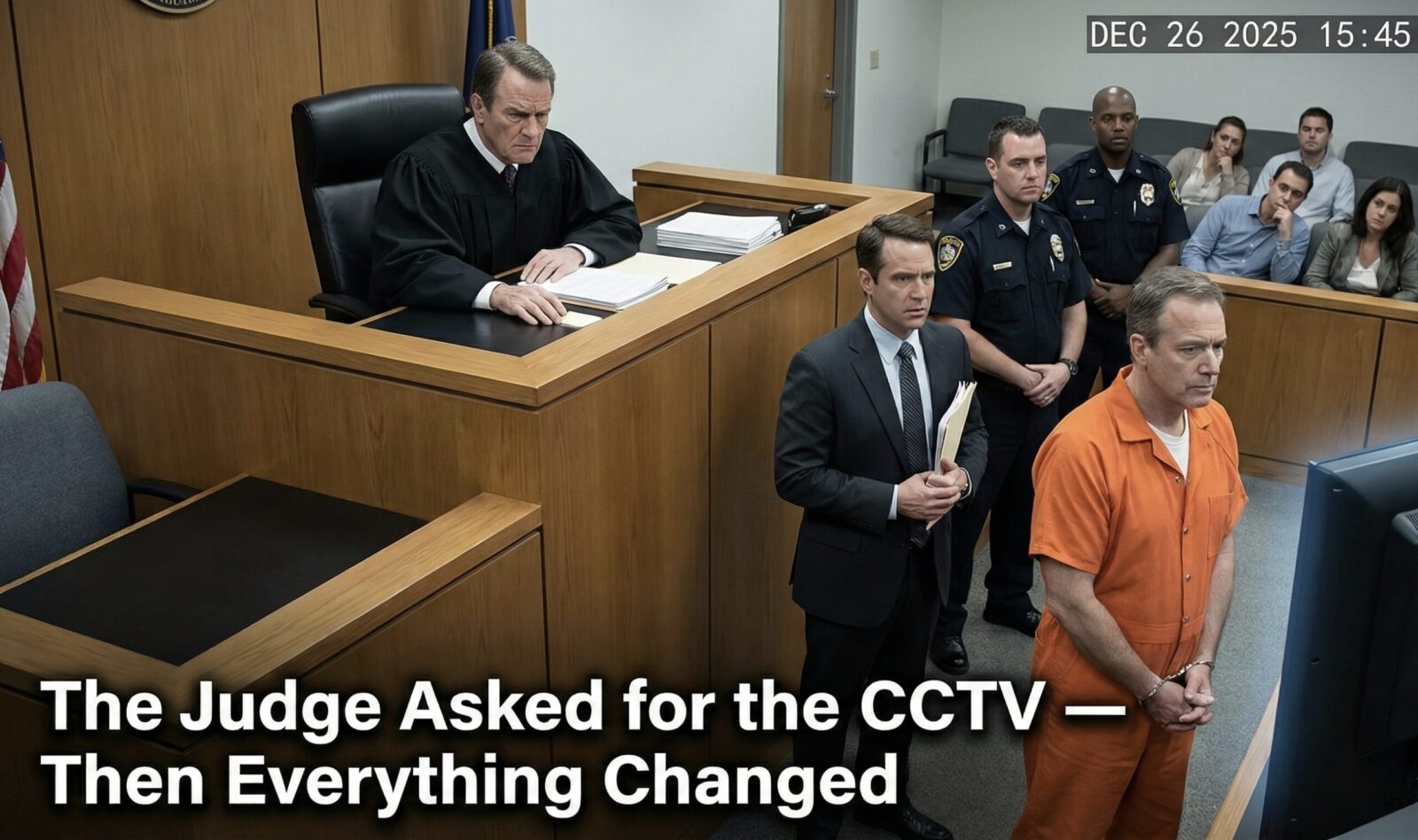

Courtrooms don’t usually feel confusing. Most of the time, things are loud or clear. Someone is arguing. Someone is defending. Someone is being accused. But that day felt different from the start. It wasn’t loud. It wasn’t dramatic. It was quiet in a strange way, like something important was about to come out but nobody knew what yet.
The judge was already seated when the hearing started.
He looked calm. Almost too calm. He flipped through a thick file, page by page, without saying much. His face didn’t show anger or sympathy. Just focus. Police officers stood behind the defendant area like always. The public gallery was half full. People were waiting, some bored, some curious.
On the right side stood the accused.
A middle-aged man, not very tall, not very strong looking. Wearing an orange jail jumpsuit. His hands were together in front of him, fingers moving slightly. He kept looking down and then up again, like he was unsure where to look. His breathing was uneven. You could tell he was nervous, but trying hard not to show it.
The lawyer beside him spoke confidently at first.
He explained the story again. How the incident happened. How his client was being misunderstood. His words were smooth. Too smooth maybe. He had said this version many times before. The judge listened without interrupting. No nodding. No reaction.
When the lawyer finished, the courtroom waited.
The judge didn’t respond immediately.
He leaned back slightly in his chair and looked at the file again. He turned to one specific page and stared at it for a few seconds longer than usual. Then he looked up.
He asked one simple question.
He asked if there was CCTV footage from the location mentioned in the case.
The lawyer hesitated.
Just for a moment. But it was enough.
He said yes, there was footage, but it was unclear. Low quality. Not very helpful. He tried to move past it quickly, like it wasn’t important.
The judge didn’t agree.
He asked the court staff to play the footage.
You could feel the change in the room instantly.
The accused looked up sharply for the first time. His face tightened. His shoulders became stiff. The lawyer stopped talking completely.
The screen turned on.
It wasn’t dramatic footage. No action. No chaos. Just a grainy view of a hallway. People walking. Standing. Waiting. Nothing special at first glance.
The judge leaned forward.
He watched carefully.
So did everyone else.
Then the judge asked the video to be paused.
He pointed to the screen.
He asked the lawyer to explain something. A timestamp. A moment where the accused was clearly visible, standing somewhere he claimed he never was.
The lawyer swallowed hard.
He tried to explain it away. Said the timing might be off. Said the camera angle could be confusing. His voice wasn’t confident anymore. His sentences didn’t flow like before.
The accused stayed silent.
But his body gave him away.
His hands stopped moving. His jaw tightened. His eyes didn’t leave the screen.
The judge asked to play the footage again.
This time, slower.
The room felt cold.
The public leaned forward. Some people whispered before stopping themselves. Police officers remained still, but their attention sharpened. This wasn’t routine anymore.
The judge paused the video again.
He didn’t raise his voice.
He didn’t accuse anyone loudly.
He just asked the accused one question.
He asked if he wanted to explain why the footage placed him at that location.
The man took a deep breath.
He opened his mouth.
Then closed it.
He looked at his lawyer, then back at the judge. His voice came out low, shaky. He said he didn’t remember being there. That maybe he was confused.
The judge nodded slowly.
Not in agreement. In understanding.
He closed the file gently and placed his hands on the bench.
He said something that surprised everyone.
He said the court would stop the proceedings right there.
The lawyer tried to speak.
The judge raised his hand slightly.
Silence.
He explained that the evidence needed further review. That the CCTV footage raised serious questions. That the court could not ignore what was clearly visible.
The accused’s shoulders dropped.
Not in relief.
In defeat.
The public stayed quiet. No reactions. No drama. People were processing what they had just seen.
The judge stood up.
He didn’t look angry. He didn’t look satisfied either. Just serious. He announced the adjournment and walked out.
The screen went black.
The courtroom stayed silent for a few seconds after he left.
Police then stepped forward slowly. The accused followed them without resistance. His head was lowered now. His earlier nervousness had turned into acceptance.
Later, people would talk about this case.
Some would say the CCTV saved the truth. Others would say the accused never stood a chance. Everyone would have an opinion.
But for those who were there, one thing was clear.
The truth didn’t come out through shouting.
It came out quietly.
Through a camera that never lies, and a judge who chose to look closely instead of rushing.
And that’s what made that day unforgettable.