
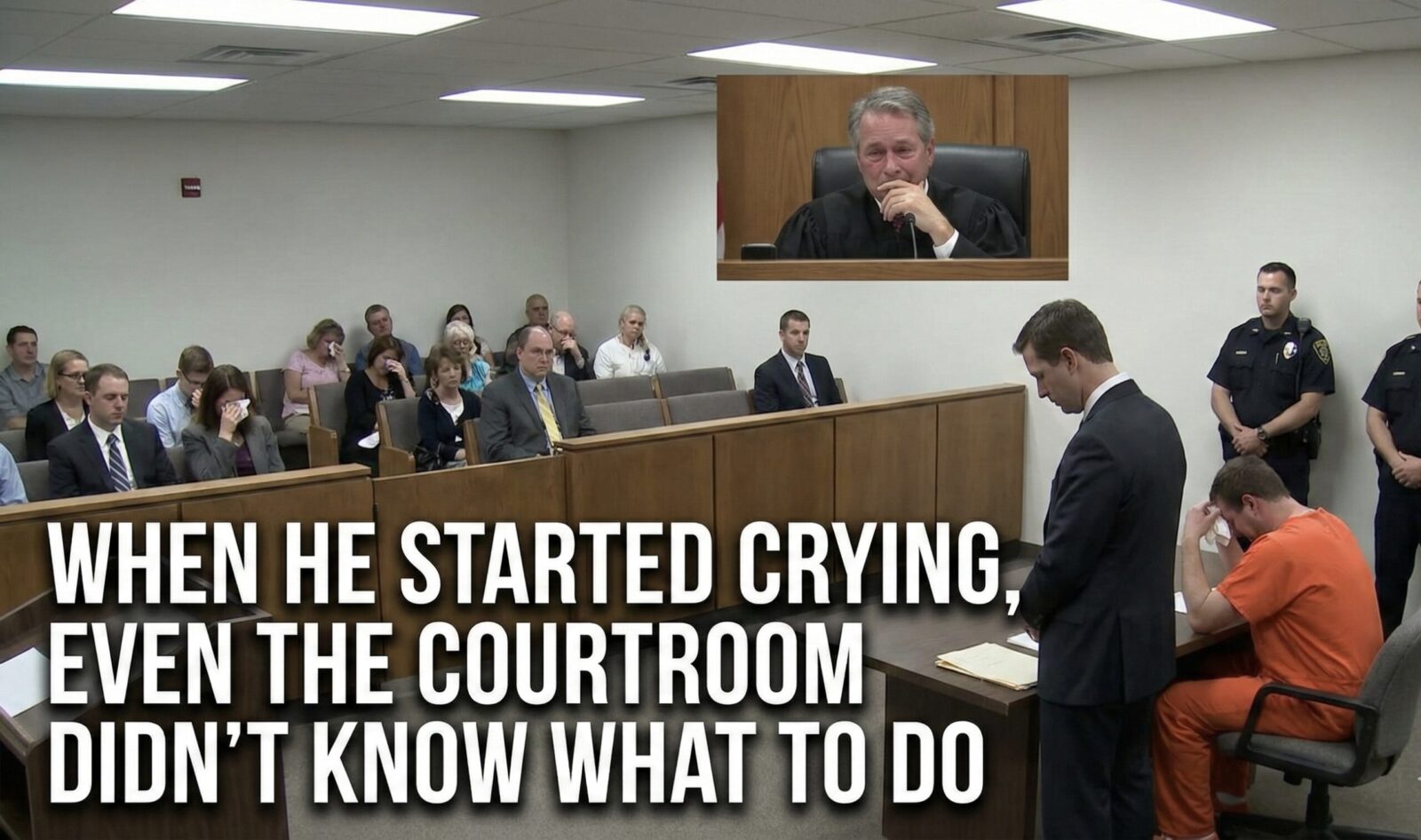

Most people think criminals don’t cry. Or maybe they think if they cry, it’s fake. That day proved how wrong that thinking is. The courtroom was not ready for what happened, not even the judge.
The hearing started normal. Nothing special. The judge sat at the bench, straight posture, face blank. Police were standing in their usual place. The public gallery had some people, not too many. Some were just sitting, some whispering before silence came.
The criminal was already standing.
He looked quiet. Too quiet. A man in his early thirties, wearing the orange jail jumpsuit. It looked old and loose on him. His head was down. Hands in front, fingers locked together like he was holding himself tight. From far away, he looked calm. But if you looked close, his hands were shaking.
The lawyer spoke first.
He explained the case like always. Charges, dates, facts. His voice was clean and professional. No emotion. Just words. He then asked if the accused could speak.
For a moment, the judge didn’t reply.
He looked at the man standing there. Long look. Then he nodded slowly.
The man lifted his head.
At first, nothing came out.
His mouth opened, then closed again. He swallowed. Took a breath. Then another. His voice came out low and broken, like he hadn’t used it properly in a long time.
He said he knew everyone thought he was a bad person.
He didn’t argue that.
He said he made mistakes. Big ones. He wasn’t denying it. That already surprised some people. No excuses. No shouting.
The room got quiet.
Then he started talking about his childhood.
Not in a clean story way. It was messy. He jumped from one thing to another. Foster homes. Moving again and again. Never staying long. He said he learned early that crying doesn’t help, because nobody comes.
The judge stayed still.
The public leaned forward without realizing it.
The man talked about his sister. Younger than him. How he used to make sure she ate before he did. How he left school early to work. His voice shook when he talked about losing contact with her after jail.
Then his voice cracked.
He stopped speaking.
Tears started coming before he could stop them. He tried to wipe his face fast, like he was ashamed. He said sorry. Not to the court, but like to himself. He said he didn’t mean to cry.
But he couldn’t stop.
His shoulders started shaking. He bent forward a little, hands covering his face. The crying wasn’t loud, but it was heavy. Deep. Like something breaking inside him that was held for years.
Nobody spoke.
Not the lawyer.
Not the police.
Not the judge.
The courtroom felt frozen.
Some people in the gallery looked shocked. One woman wiped her eyes quickly and looked away. Even a police officer shifted his weight, uncomfortable.
The man tried to speak again.
He talked about the night of the crime. How tired he was. How desperate. How he knew what he was doing was wrong, but his head wasn’t thinking straight. He said that one moment destroyed everything. His future. His family. Himself.
He cried harder now.
Not begging. Not acting. Just broken.
The judge’s face changed.
It wasn’t obvious, but it was there. His jaw tightened. His eyes looked heavy. He leaned back slightly, listening carefully. He didn’t stop the man. He didn’t rush him.
When the man finally stopped, the silence felt loud.
The judge didn’t speak immediately.
That pause felt emotional. Too long. Like he needed time.
When he finally spoke, his voice was still firm, but softer. Different.
He said the court hears many stories, but not many honest ones. He said law doesn’t allow him to erase crimes, but it does allow him to see the person standing there, not just the file.
The judge paused again.
He cleared his throat. His eyes were shining slightly. He didn’t look away.
He spoke about responsibility. About punishment. But also about rehabilitation. About how the system is not only to punish, but also to understand when possible.
The decision he gave was balanced.
Not easy.
Not cruel.
The man nodded again and again, still crying, but calmer now. He didn’t say thank you. He just nodded. Like someone who finally felt heard for the first time.
When the judge stood up and left, nobody moved.
People stayed seated for a moment. Quiet. Processing.
Later, outside the courtroom, people talked softly. Some were surprised. Some confused. Some emotional.
But one thing was clear.
That day, the courtroom didn’t just see a criminal.
It saw a human being fall apart and finally tell his truth.
And that moment stayed longer than any sentence ever could.