

The courtroom did not feel dramatic at first.
There were no raised voices, no sudden movements, no gasps from the audience. It looked like any other weekday proceeding inside a modern American courthouse—bright fluorescent lights, pale walls, polished wood benches, and the quiet hum of air conditioning circulating through the room.
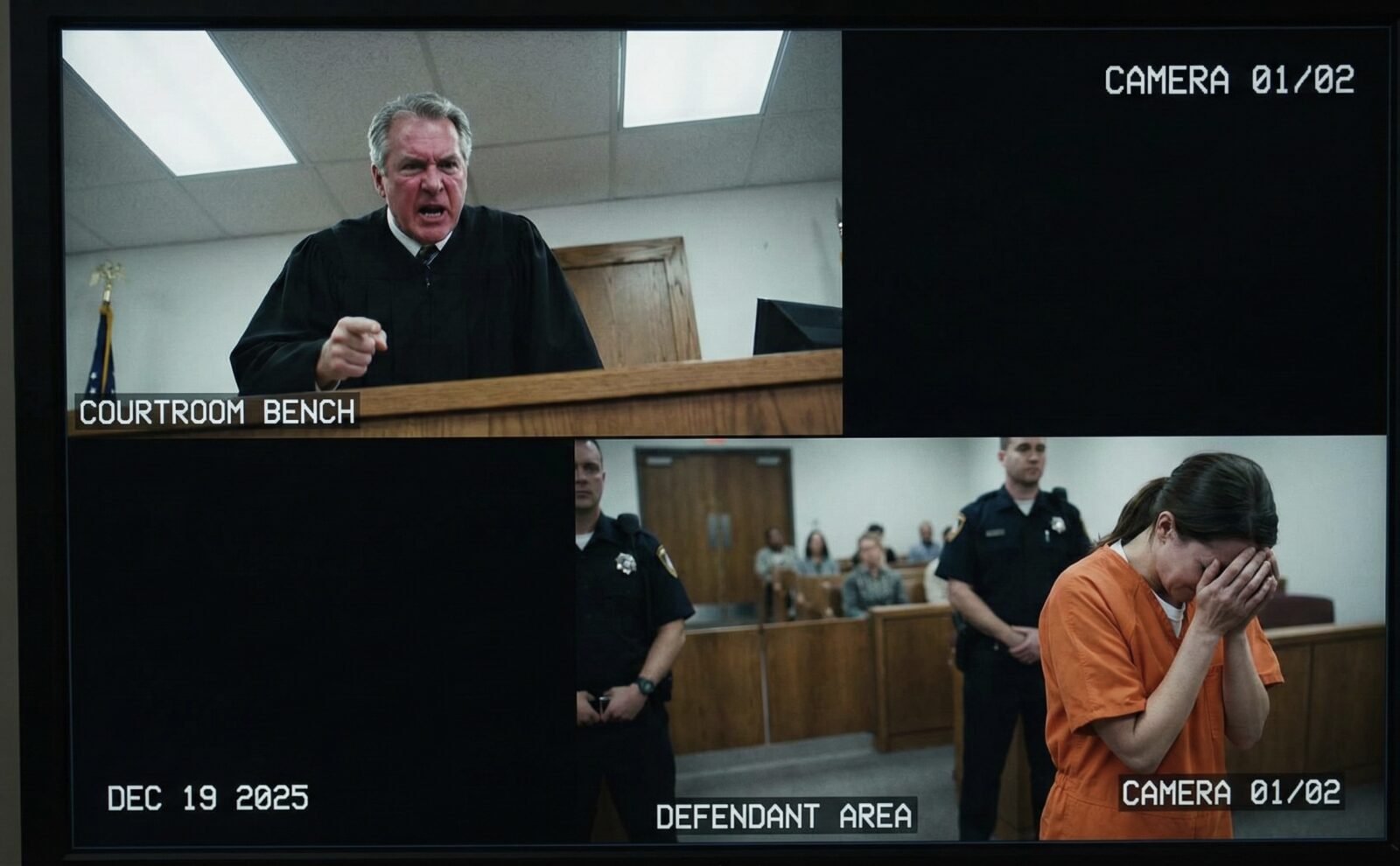
High above, fixed to the walls, CCTV cameras recorded everything without emotion.
They did not care who was guilty.
They did not care who was afraid.
They simply watched.
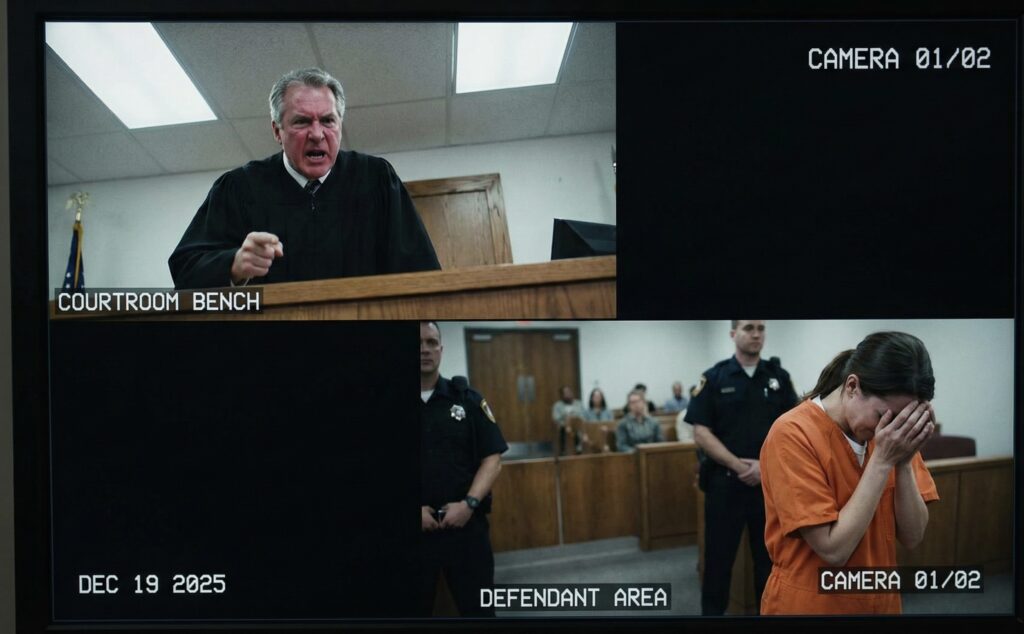
In the footage, the room appeared divided—not by law, but by perspective.
In the upper frame, the judge sat behind the bench, straight-backed and still. His black robe fell neatly over the chair, his hands resting calmly in front of him. He was not a loud man by nature. Years on the bench had taught him restraint, control, and the importance of measured authority.
In the lower frame, the woman stood alone.
She wore an orange jail-issued jumpsuit, its color harsh against the neutral tones of the courtroom. She stood on the right side of the defendant’s area, shoulders tight, hands held together in front of her. Her posture suggested fear even before her face did.
She did not speak.
She had not spoken since she was brought in.
The Warning
When the judge finally spoke, his voice was firm but steady.
There was no shouting. No dramatics. Just a clear, serious explanation of what the court had reviewed and what it meant. He spoke about actions taken without thought, about responsibility ignored, about how the law does not bend simply because regret appears too late.
His tone carried weight—not anger, but disappointment.
The kind that comes from seeing the same mistakes repeated again and again.
The woman’s fingers trembled.
It was subtle, almost unnoticeable unless one looked closely. Her eyes stayed fixed on the floor, tracing invisible lines between tiles. She knew better than to look up. Looking up made things real.
The courtroom remained silent.
The police officers stood unmoving.
The lawyer beside her did not interrupt.
The public watched, sensing the pressure building.
This was not a speech meant to scare.
It was a warning meant to be understood.
The Shift
The judge continued speaking.
Slowly, his voice began to rise—not sharply, not unpredictably, but with purpose. His posture changed slightly. He leaned forward, elbows nearing the bench, eyes locked straight ahead.
Frustration crept into his expression.
Not personal frustration—principled frustration.
He spoke about consequences, about the danger of reckless choices, about how the court could not ignore what had been done simply because remorse had arrived late.
The woman’s composure began to crack.
Her jaw tightened as her eyes filled with tears she desperately tried to control. Her shoulders lifted slightly, her breathing growing shallow. She swallowed hard, fighting the urge to react.
She remained silent.
No excuses.
No explanations.
No words.
The silence itself felt heavy.
The Moment of Impact
Then the judge stood.
Not suddenly.
Not violently.
He rose with slow, deliberate control, the movement itself commanding attention. The room seemed to freeze the instant his feet touched the floor.
Authority does not always need noise to be felt.
But when his voice followed, it filled the room.
He shouted—not wildly, not chaotically—but with controlled force. His words echoed off the walls, sharp and unmistakable. This was anger shaped by responsibility, disappointment sharpened into resolve.
He spoke of accountability.
Of the seriousness of what had occurred.
Of the court’s duty to protect, not excuse.
The sound struck the woman like a physical force.
Her restraint shattered.
A sob escaped her before she could stop it. Her shoulders shook as tears spilled freely down her face. She raised a hand to cover her mouth, then her eyes, as if hiding could soften the reality of what she was hearing.
She cried openly now.
Still, she did not speak.
No pleading.
No justification.
Only the raw sound of fear and regret.
The officers remained still.
The lawyer did not intervene.
The public did not move.
Everyone understood: this was not theater.
This was judgment.
The Final Authority
The judge did not sit back down.
He remained standing, chest rising and falling as he continued speaking. His voice lowered slightly—not calmer, but more controlled. The anger had settled into certainty.
He laid out instructions clearly.
He outlined consequences without hesitation.
He spoke with the finality of someone who knew the weight of every word.
His eyes remained fixed forward.
In the lower frame, the woman’s crying softened into quiet sobs. Her head dropped fully now, chin nearly touching her chest. Her body seemed smaller, as if the weight of the moment had pressed her inward.
She stood there, silent, broken, listening.
The courtroom did not react.
It did not need to.
What the Camera Captured
The CCTV footage lasted only moments, but it captured something rare.
There was no dramatic music.
No cinematic angle.
No exaggerated motion.
Just a fixed camera recording a moment when authority confronted consequence, and fear met reality.
The judge was not cruel.
The woman was not theatrical.
The room was not staged.
It was simply the law doing what it exists to do.
Later, people would watch the clip online and argue about what they saw. Some would focus on the judge’s anger. Others on the woman’s tears. Many would project their own assumptions onto fifteen seconds of footage.
But the camera told a simpler story.
A story of restraint breaking under pressure.
A story of silence speaking louder than words.
A story where no one needed to shout except the law itself.
And when the footage ended, the courtroom returned to quiet—
but the weight of that moment stayed long after the screen went dark.